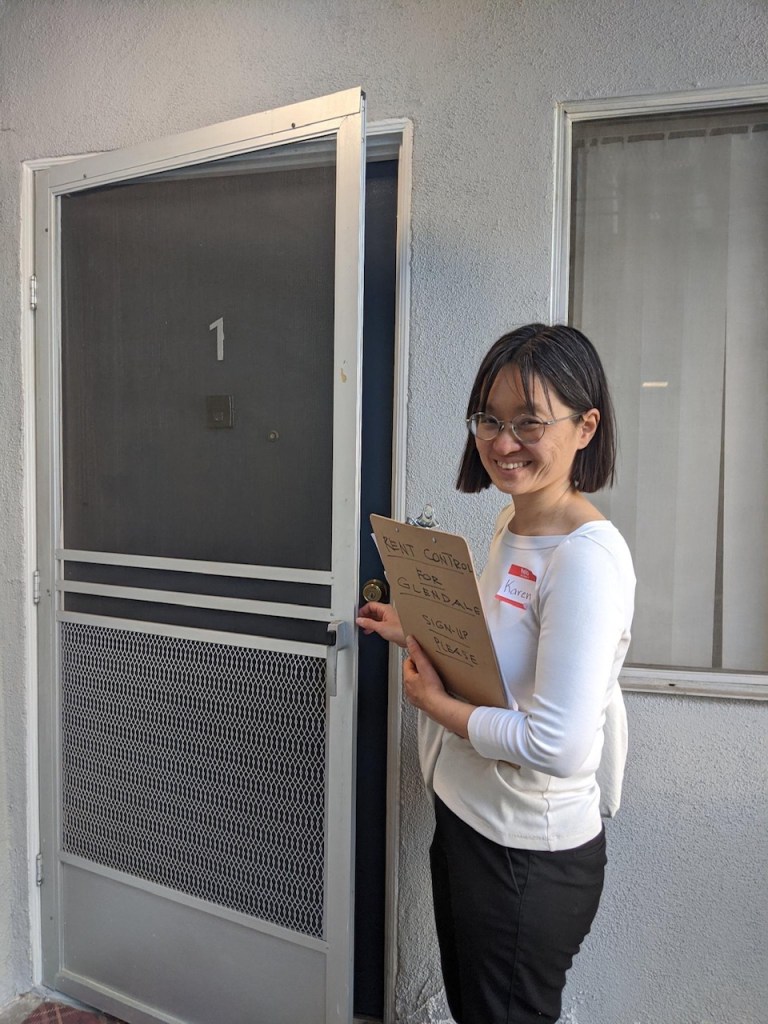
A City Hall for Everyone!
I first found my way to City Hall this way:
In August 2017, I met activists from Food and Watch Watch at the Metropolitan Water District of Southern California (MWD) to speak about the proposed Delta Tunnels. Then they said, “Hey Karen, we’re going to meet with Glendale City Councilmembers tomorrow. Would you like to join us, as a Glendale resident?”
I said, “You mean ordinary residents can meet with City Councilmembers to discuss policy? YES!!!!”
I have been attending Glendale City Council meetings ever since. And this is exactly what I would like to see all Glendale residents do–make our voices heard in City Hall, to make City Hall work for us. I have short-term, intermediate-term, and long-term plans to make this happen.
Signs. When I walked around Pasadena City Hall, I saw many signs in front of city offices, to tell residents which office they needed to go to for which services. In contrast, Glendale’s City Hall is difficult for people to know where to go for which city services. This could be a simple change to help connect Glendale residents with city services.
Community Liaison. In May 2023, my friend Teal Marchande and I sent a proposal to the City Council to create a new position of Community Liaison. As community advocates, we often help Glendale residents navigate city services. We could be more effective if we had an official connection with the City, however, so that City departments would know who our Community Liaisons are, and help us work with residents who need their services. The City will start a pilot project to launch our new Community Liaisons, on a volunteer basis.
Council Districts. The current at-large system of electing the City Council produces 5 out of 5 Councilmembers who are homeowners in North Glendale. Let’s change this to a district system so that all areas of the City will be guaranteed representation in every election, regardless of which individuals get elected. The Council Districts measure will be on the ballot in November 2024.
I have advocated for Council Districts for many years, and know that this issue can be abstract and hard to understand, so here is an analogy inspired by spending my afternoons with 5-year-olds:
Imagine that you have a classroom with 20 students and two teachers. This meets the requirement of one adult for each 10 children, but both teachers spend 99.9% of their time in the Northern half of the classroom, while the kids in the Southern half see 0.1% of the teachers’ time. You would think that there is something wrong with a system that produces such an unjust result, would you not? The people in the Northern half do not mind getting 99.9% of the teachers’ time; it is the people in the Southern half who call out that this system is unfair and needs to change to a system where we are guaranteed representation in every election.
Full-time Councilmembers. People are astonished when I tell them that City Councilmembers are paid about $18K a year for what is considered a part-time job. Most people cannot live on $18K a year, so the people who can afford to serve on the Council are a) independently wealthy, b) retired, or c) need to spend significant time earning other income, with takes away from the time and energy they can spend on City issues. The City Council job needs to be a full-time job, with a full-time salary that is pegged to the area median income (AMI), so that Councilmembers are always aware of the struggles of the average household in Glendale.
In contrast, the unelected City Manager has a compensation package of over $450K and was recently granted a raise of 30%. We need to make sure that our elected Councilmembers who are accountable to the people of Glendale have a greater say in how we run our city. Councilmembers need to be able to devote their full-time efforts to work on City issues.
City Department Heads. Our City Manager and our City Councilmembers currently serve on short-term contracts. Similarly, the people who head each City department should also serve on short-term contracts. This change, however, would require a modification to the City’s charter.
Campaign Finance Reform. Let’s expand the public financing of campaigns so that more working people and middle-class people get their voices heard in City Hall, by matching contributions from small donors.
Voting Records of City Councilmembers. This idea came from a voter! It would be very helpful to Glendale residents if we could easily see how our Councilmembers voted on all issues. These records are faithfully noted by our City Clerk’s office, so it should simply be a matter of collecting this data and organizing it in a way that makes it easy for voters to find and read.
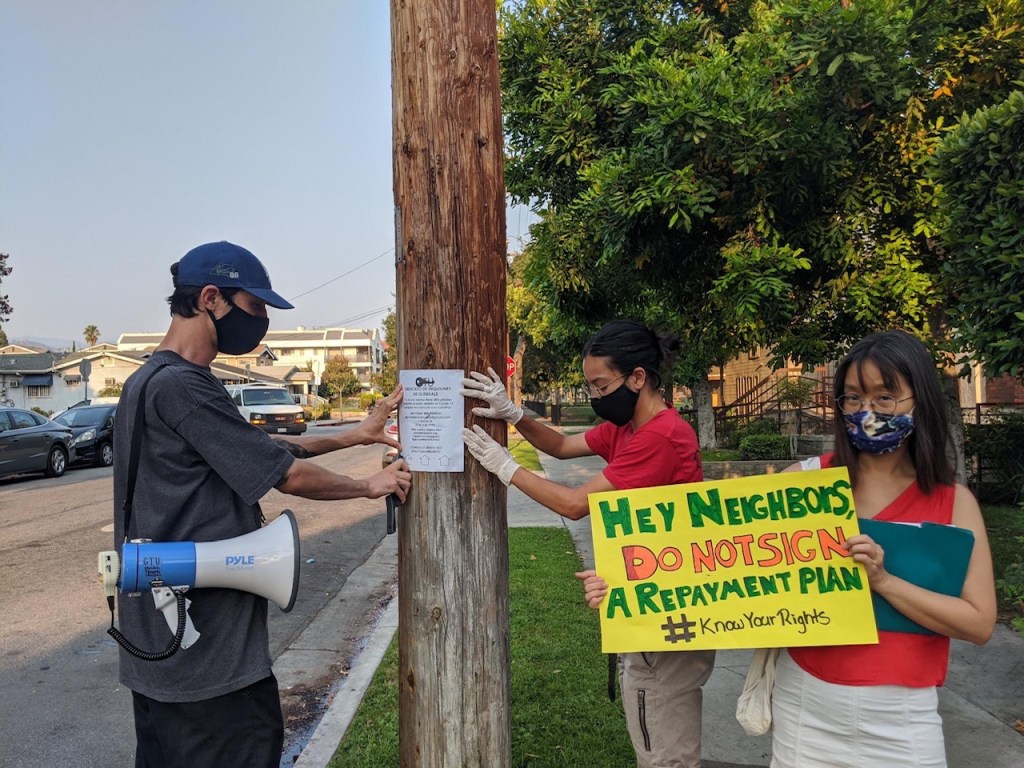
Renters’ Rights
I am an all-purpose activist and will fight where I can make the greatest difference. In the last five years, I have focused on the housing crisis—the #1 issue in LA County. Over 70,000 Glendale residents are rent-burdened tenants who live on the edge of becoming homeless, and I have worked to keep us housed. Throughout the pandemic, my fellow tenant advocates and I advised our fellow renters of their rights under ever-changing emergency housing laws passed by the federal, state, county, and city governments.
- Right to Counsel. About 90% of landlords show up in eviction court with lawyers, but only about 10% of tenants have lawyers. We need to make sure that all tenants who need lawyers have one, to level the playing field and make sure that all existing laws are applied fairly. Doing nothing to change this huge injustice means that we are okay with tenants getting illegally evicted by landlords who will likely get away with it, 90% of the time.
- TOPA or Tenant Opportunity to Purchase Act would introduce a new model of affordable housing, where tenants can buy the building they live in and share ownership of tenant-led, limited equity co-ops. This would allow tenants to build equity instead of paying rent, with nothing to show for it at the end of every month (also known as throwing money down a black hole, never to be seen again). These purchases are currently financed via Community Land Trusts, but can be financed in a number of different ways, including via Public Banking (see below).
- Tenant-Landlord Committee. I worked with the Coalition for an Anti-Racist Glendale tenant advocates, and the City Council in 2021 to make this committee a reality, so we can discuss and resolve issues in an open and fair way. Recent reviews of Glendale’s Rental Rights program have shown that we need to turn this “ad hoc” Committee into a permanent City Commission, to address the continuing needs of tenants.
- Back-Rent Repayment Plan: On October 20, 2020, I convinced the Glendale City Council to align the city’s plan for the repayment of back rent with the state’s plan, which made life simpler for thousands of tenants and landlords.
- Anti-Harassment Ordinance. The pandemic has seen a 300% increase in harassment cases, which can be hard to prove. Let’s pass a law that defines and bans harassment, like LA’s recent law.
- Full Replacement of Affordable Units. State law allows Glendale to replace every demolished apartment unit that has been rented within the last five years with an affordable unit. Let’s make sure Glendale developers provide the maximum affordable housing for all the benefits given by the city and the state.
A Clean Future
Clean Water. Water is the first issue that took me to the Glendale City Hall in August 2017, in the company of water activists from Food and Water Watch. Water is a universal human need for us all, and a universal need for our plant and animal life, as well. We need to make sure that we safeguard our water supply as well as our water quality.
It’s a miracle that most of us are living here today, because local water sources would support only one million people. Ten million people live in LA County today thanks to water imported by aqueducts. I’d like to work with the Metropolitan Water District on projects to capture and reuse local stormwater.
Our water should be free of PFAS and microplastics.
Clean Energy. I worked with environmental advocates on the Grayson Repowering Project beginning in 2017, which reduced the amount of natural gas used by Glendale’s power plant from the planned 262 MW down to 55 MW. In 2023, I served on the Stakeholder Techincal Advisory Group (STAG) for Glendale Water and Power’s (GWP) Integrated Resource Plan (IRP), and am happy to report that we successfully convinced the City Council to implement Glendale’s plan to reach our clean energy goals by 2035, as opposed to meeting the state’s slower goal of 2045.
Proud Treehugger. Let’s plant more trees that our grandchildren will enjoy in 50 years, especially in South Glendale. With every decision we make, across all issues, we need to consider what kind of future we want to shape for our children and grandchildren, to leave them a better world than the one we inherited.
Transportation
I am 49 years old and I don’t know how to drive—this fact astonishes people, especially around LA. I have always lived in or near large cities like Honolulu, New York, and Boston, and I relied on public trains and buses to commute to work. Most of all, I love to walk, and you really get to know a city when you consistently walk around it. A big reason why I moved to Glendale is because I can walk to everything I need in about 30 minutes—that includes regular walks to and from City Hall, even when City Council meetings end at unpredictable hours of the night.
The City of Glendale has a beautiful Pedestrian Plan from 2017, filled with practical steps on how to make our streets safer for pedestrians. Pedestrians include our children, who do not yet know how to drive; our seniors, who may no longer feel confident driving; and our wheelchair residents. Making our streets safer for pedestrians is a transit issue, and environmental issue, and also an equity issue. Unfortunately, however, implementing this plan has not been a high priority for City Hall. As pedestrian, I have a personal stake in implementing our Pedestrian Plan, together with our update Bike Plan. The people who will work hardest on issues are the ones who live them every day, and walking and public transit are part of my daily life.
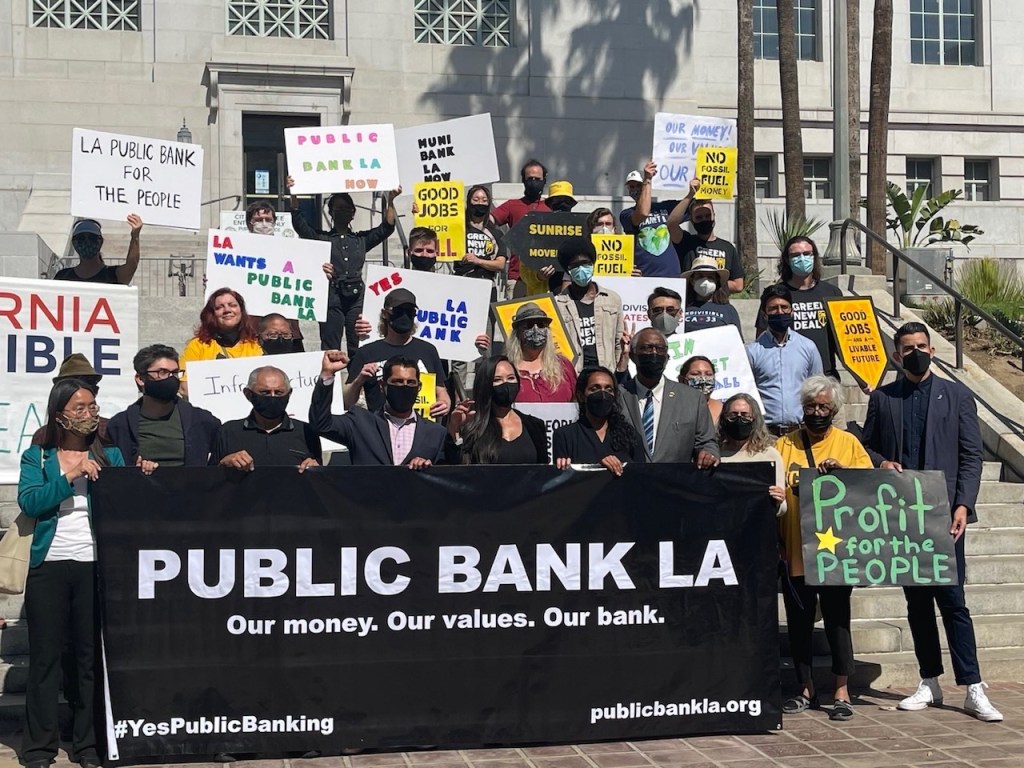
“It’s a Wonderful Bank”
Someone told me that saying public bank would put people to sleep, so I refer you to the classic film “It’s a Wonderful Life,” which does a beautiful job of showing how a community bank can help people buy their own homes and start small businesses. For local and state governments, public banking will pay for many improvements in our communities. At the federal level, Modern Monetary Theory (MMT) will “pay for” these programs.
- Imagine cutting the cost of large public projects in half—we could do this with a public bank! Half the cost of a large infrastructure project is paid in interest on bonds, so for a $500 million project, Glendale could save nearly $250 million by financing it with a public bank instead of bonds.
- A public bank would also save the City millions of dollars in bank fees every year.
- A bank with a mandate to serve the public will help tenants finance the purchase of tenant-led, limited-equity co-ops and offer financing to historically underserved groups to start and expand small businesses.
Racial Justice
Racism runs far more deeply through the structure of our society than the way an individual might treat another individual. The Sundown Town resolution passed by the Glendale City Council on Sept. 15, 2020 recognizes this fact by showing how racism has historically been expressed in Glendale’s housing practices. Many of my policy proposals address specific ways in which historical racism can be corrected with housing, banking, and government reforms. For example, 75% of white households are homeowners but only 45% of Black households own their own homes, nationally; let’s create policies that correct this imbalance, like TOPA. That is the job of a politician, after all—to translate stated principles into policies that affect our daily lives, and I am happy to work with the Coalition for an Anti-Racist Glendale to build a city that welcomes diverse voices.
 Karen Kwak